When people ask what my workday looks like, they often imagine calculations, models, and technical frameworks. And while that is part of the job, it’s rarely where most of the time goes. In practice, sustainability work has long been shaped by something far more mundane: projects.
A typical sustainability task starts with a request. What’s the footprint of this product? Can we update an EPD? What happens if we change a material or a supplier? The question sounds simple, but the work quickly becomes about reconstruction. Data is pulled from spreadsheets, PDFs, old reports, and inboxes. Assumptions are checked. Background data is verified. The work isn’t about improving anything yet — it’s about reassembling what already exists.
For a long time, this project-based way of working was the norm. Each assessment was treated as a discrete effort with a clear start and end. Once delivered, the result was filed away, even though the underlying data would soon be outdated. When the next request came, the process began again.
That said, it’s important to acknowledge that many organisations — particularly those with LCA competence in-house — have already moved beyond this. In these teams, the work is less about creating new models from scratch and more about maintaining, updating, and refining existing ones. That continuity makes it far easier to reuse results for R&D, scenario testing, and product development.
The challenge is that not all companies are set up this way. For organisations where sustainability analysis is largely handled as an external or “on-demand” service, the work still tends to fall back into separate projects. Each request becomes harder to revisit, harder to build on, and harder to connect to everyday decisions.
This difference in setup has a real impact on how sustainability teams can operate. When data lives inside one-off projects, the role becomes reactive by design. Time goes into responding to new requests rather than proactively exploring improvements. Sustainability becomes something you report on after decisions are made, instead of something that helps shape them.
What I’ve seen change — and what increasingly defines modern sustainability work — is the move away from project-based reporting toward reusable data. Instead of treating each LCA or EPD as a standalone exercise, materials, processes, transport, and packaging are structured as shared components. They are defined once, maintained over time, and reused across products and reporting needs.
This shift changes the workday in very practical ways. Updates no longer trigger new projects. Improvements don’t require rebuilding models. Sustainability teams spend less time chasing inputs and more time understanding impact. Product teams can test changes before committing to them. Procurement can see the environmental consequences of supplier choices without waiting for a report.
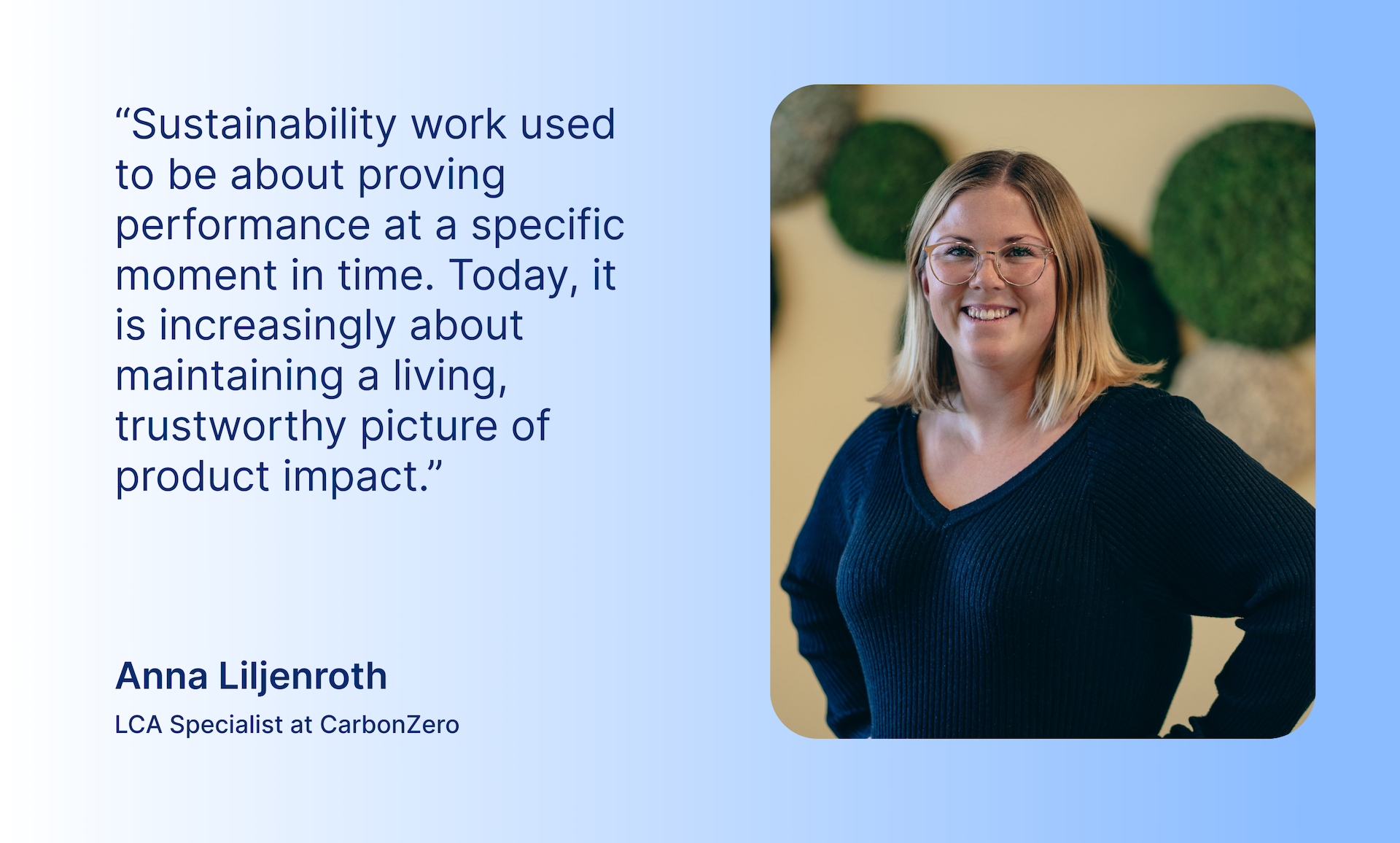
Looking back, sustainability work used to be about proving performance at a specific moment in time. Today, it is increasingly about maintaining a living, trustworthy picture of product impact. And looking ahead, the direction is clear: sustainability data is becoming part of everyday decision-making, not something reserved for reporting cycles.
That evolution also changes the role itself. The focus moves from delivering documents to enabling better choices. From answering “Can we report this?” to asking “What should we do next?”
This is the context in which platforms like EandoX have emerged — not to replace the way advanced sustainability teams already work, but to make that structured, reusable approach accessible to more organisations. By supporting shared data foundations rather than isolated projects, it becomes easier for companies — regardless of team size — to work with sustainability data in a continuous, connected way.
And once teams experience that shift, it becomes clear why project-based reporting is something many are ready to leave behind.